 TreiD
The best 3D printer under 300 is the one that still leaves money for plastic. A printer with nothing to print is just a loud shelf ornament. In November 2026 this budget buys far more than it used to: my pick for most first-timers is the Elegoo Centauri 2, a CoreXY printer with a 256 mm cube build volume at $244 or €229 (as of 7 Nov 2026). The other four picks each trade something away, and I list the well-known rivals I left out, with the reason for each.
I treat $300 or €300 as the whole starting budget, not the sticker price, and I checked every price on the maker’s own store on 7 Nov 2026. Where I write from experience, it’s from printers I’ve owned: the Ender 3 Pro I bought in 2019, the Ender 2 Pro I returned after about 100 hours, my Biqu B1 and my Bambu Lab P1S. AdditiveRealm hasn’t tested any of the printers recommended below, so each pick rests on the maker’s published specs and, where I say so, on an independent review.
What $300 or €300 Really Buys in a 3D Printer in 2026
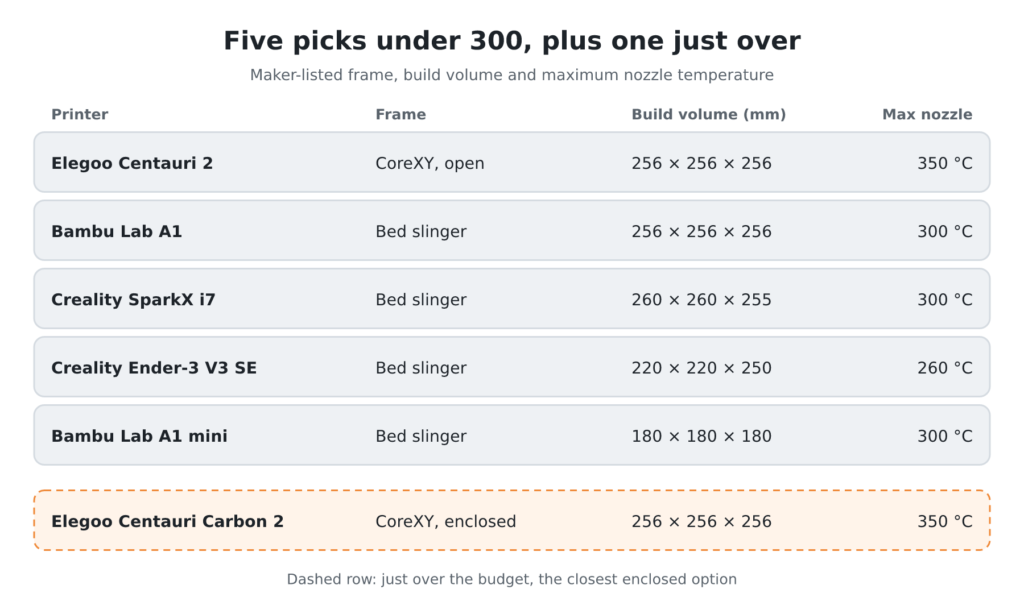
This budget used to mean a bed slinger, an open frame where the bed carries the print back and forth. Automatic leveling is now the norm in this class, direct drive is common, and CoreXY has arrived: Elegoo lists the Centauri 2 as a CoreXY printer with a 350 °C nozzle at $244, down from $299 (as of 7 Nov 2026). What still sits just past the line is a full enclosure, which I come back to below.
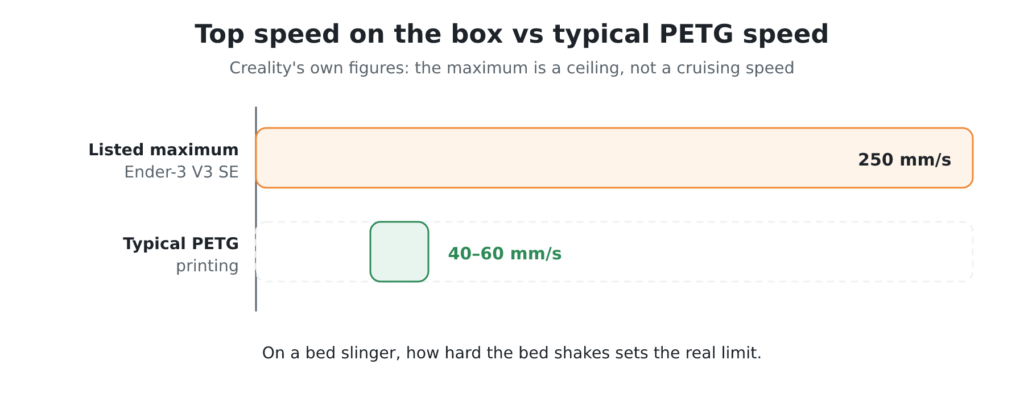
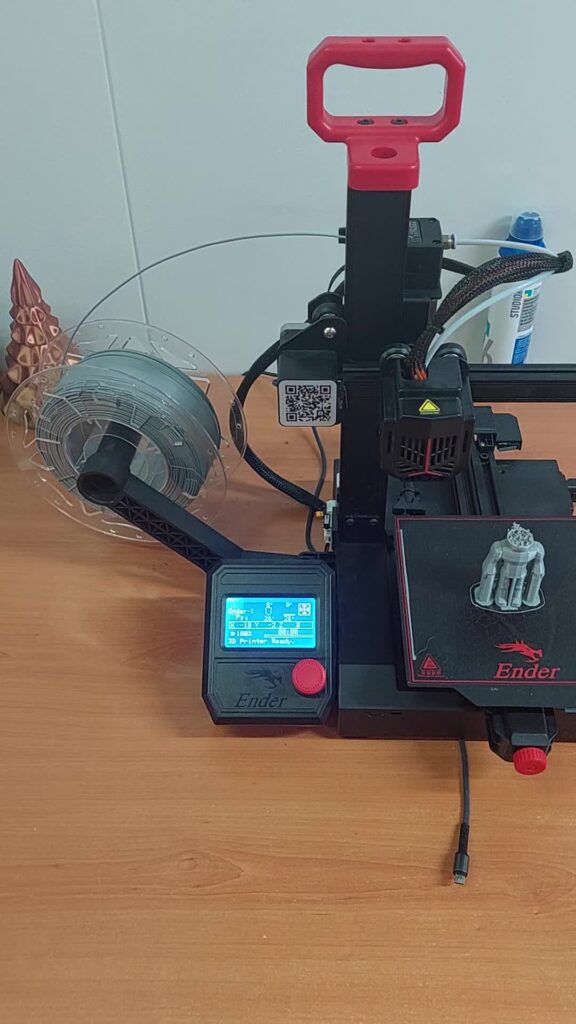
The Creality Ender-3 V3 SE is the typical bed slinger at this price. Creality’s own Ender series comparison lists it with direct-drive extrusion, automatic CR Touch leveling and a 250 mm/s maximum print speed.
Read any maximum speed as a ceiling, not a cruising speed. Elegoo’s own spec table lists the Centauri 2 at up to 500 mm/s but recommends 250 mm/s, and Creality’s PETG settings guide puts typical PETG printing at 40–60 mm/s. On a bed slinger the real limit is how hard the bed shakes, not the number on the box.
The Real Budget: Printer Plus Your First Month of Filament and Spares
Here is what each pick leaves of a $300 or €300 budget at the maker’s store price on 7 Nov 2026. Several are Black Friday prices, so recheck them before you buy. A ‘—’ means I have no store price in that currency: Bambu Lab’s store redirected my US visit to its EU shop.
| Printer | Price US / EU | Left of 300 |
|---|---|---|
| Elegoo Centauri 2 | $244 / €229 | $56 / €71 |
| Bambu Lab A1 | — / €239 | — / €61 |
| Creality SparkX i7 | $279 / €199 | $21 / €101 |
| Creality Ender-3 V3 SE | $199 / €194 | $101 / €106 |
| Bambu Lab A1 mini | — / €179 | — / €121 |
Creality lists the Ender-3 V3 SE at $199 on its US store, and in Europe a €194 bundle comes with four Ender PLA spools, two of them advertised as free. The Bambu Lab EU store has the A1 mini at €179 and the A1 at €239, with €189 and €259 shown as their 30-day lowest. Creality’s US and EU stores list the SparkX i7 at $279 and €199, and Elegoo’s EU store has the Centauri 2 at €229, down from €299.
That margin is why I don’t pick the best 3D printer under 300 by sticker price alone: in the US the SparkX i7 leaves $21 for plastic, while the Ender-3 V3 SE leaves $101. Elegoo sells its own PLA from $13.99 a spool, so the Centauri 2’s $56 margin covers four spools and nothing else.
My month-one list for a $300/€300 starter is short. It’s PLA for learning, one spool of PETG once your first layers are reliable, a couple of spare nozzles and a scraper. Spare nozzles are the item I’d never skip, because a clog with no spare in the drawer means the printer sits idle until one arrives.
Keep part of the leftover money for whatever breaks first. The plastic extruder arm on my Ender 3 Pro cracked after around 35 hours of printing, and the printer arrived without an X-belt tensioner, so I bought one separately. Newer designs have fixed some of this, but a first printer will still surprise you.
The Best 3D Printer Under 300: One Pick for Each Trade-Off
Pick 1, the most printer for the money: Elegoo Centauri 2. It asks you to give up filament margin and the extras: Elegoo lists the camera, LED lighting and air filter as optional expansions. In return you get CoreXY motion, a 256 × 256 × 256 mm build volume, a 350 °C nozzle, a 110 °C bed and 121-point auto-leveling. Elegoo rates PLA, PETG, PLA-CF and TPU as ideal and ABS or ASA as not recommended, so it’s still an open-frame printer for everyday materials.
Pick 2, the least setup: Bambu Lab A1. It asks you to give up CoreXY and about €10 of filament money against the Centauri 2. Bambu Lab lists a 256 × 256 × 256 mm build volume, a 300 °C all-metal hotend and automatic calibration of Z-offset, bed level, vibration resonance and nozzle pressure before every print job. If you want to grow into colour, the same store sells the A1 Combo with the four-spool AMS lite at €339.
Pick 3, the biggest bed for Europe: Creality SparkX i7. It asks you to give up CoreXY and, in the US, most of your filament money. Creality lists 260 × 260 × 255 mm, up to 500 mm/s, a 300 °C nozzle, full-auto leveling and a 720p AI camera with lighting. Tom’s Hardware’s review, published 8 Jan 2026, calls it a bed slinger and “a well-designed, simple to build, easy to use, entry level machine”.
Pick 4, the most left for filament in the US: Creality Ender-3 V3 SE. It asks you to give up speed and bed size: Creality lists 250 mm/s and 220 × 220 × 250 mm. In exchange it leaves $101 of a $300 budget, a third of it, for filament, spares and shipping.
Pick 5, small: Bambu Lab A1 mini. It asks you to give up build volume: Bambu Lab lists 180 × 180 × 180 mm. At €179 it leaves €121, the most of any pick, and the plug-and-play section below explains why I’d take it over an older mini.
Just over the line, enclosed: Elegoo Centauri Carbon 2. This is the one to stretch for if ABS or ASA is on your list. Elegoo lists an enclosed chamber with HEPA and activated-carbon filtration, a 350 °C nozzle and the same 256 mm cube, at $319 or €309 (as of 7 Nov 2026). That’s $19 or €9 over the budget before any filament, so it isn’t a pick, but it’s the closest enclosed printer to the line I found.
Left out, and why. The original Elegoo Centauri Carbon has left Elegoo’s stores: its US page no longer exists, and its EU address now opens the Carbon 2. Creality’s K1 is $299 but sold out, the K1C is $499, and the K2 SE base model shows sold out at $279, while the K2 SE 4C that is in stock costs $359. The Ender 3 Pro is sold out too (more on buying one used below), and I skipped Elegoo’s Neptune 4 Pro because at $239 it costs only $5 less than the Centauri 2.
What Each Pick Asks You to Give Up: Size, Speed, Enclosure or Tinkering
Creality’s filament reference table sets out what each material needs. The lowest maximum nozzle temperature among my picks is the Ender-3 V3 SE’s 260 °C, and it still clears the top of every range below, so all five cover PLA, PETG and TPU. What keeps you off ABS and ASA is the open frame, not the nozzle.
| Material | Nozzle °C | Bed °C |
|---|---|---|
| PLA | 190–230 | 0–60 |
| PETG | 230–250 | 60–100 |
| TPU | 225 ± 5 | 50 ± 5 |
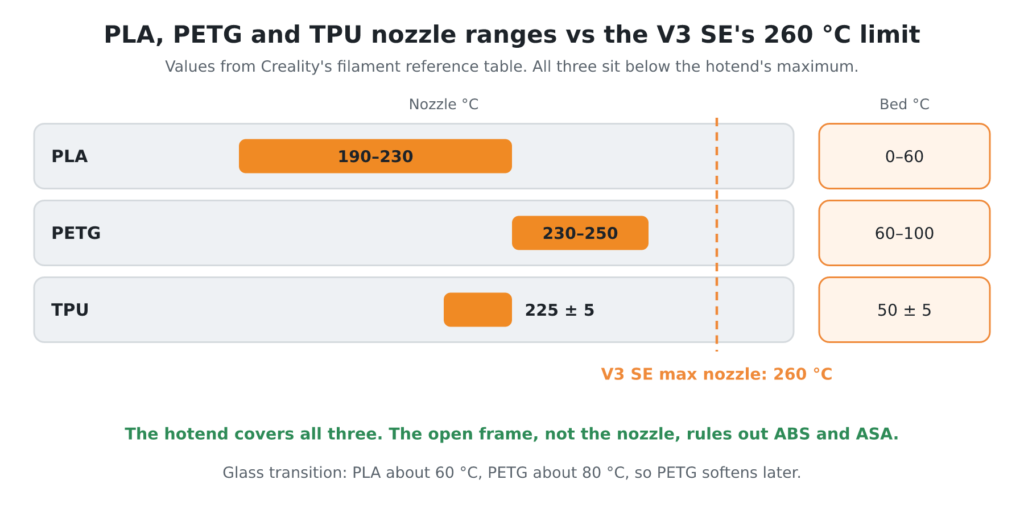
Creality’s PETG guide puts PLA’s glass transition at about 60 °C and PETG’s at about 80 °C, so PETG starts to soften at a higher temperature than PLA. The PETG vs PLA breakdown covers where each material fails.
If ABS is on your list, read printing ABS without an enclosure before you buy, or stretch to the Centauri Carbon 2. I’ve printed ABS, ASA and PETG on my P1S with the door closed, and you could still smell the fumes in the room. An open frame gives you even less control over warping and smell, which is why both Bambu Lab and Elegoo list ABS as not recommended on their open-frame picks.
Giving up size hurts less than you’d guess, until it suddenly doesn’t. Brackets, holders and figurines fit a 180 mm bed fine. A helmet or a long shelf bracket doesn’t, and you’ll be splitting models into parts. If you already know the big thing you want to print, measure it first.
Giving up speed costs you hours, and on paper the V3 SE’s 250 mm/s is half the 500 mm/s listed for the A1, the SparkX i7 and the Centauri 2. To put tuning in hours, my Biqu B1 took 1 hour 45 minutes on stock speeds for my test print and 1 hour 20 minutes on Klipper with input shaping. Scale that to a job that takes 10 hours on the tuned machine and the stock one needs about 13.
Tinkering is the cost nobody prices in. Z-wobble was the flaw I fought most on my Ender 3 Pro: a calibration cube came out 0.2 to 0.4 mm off depending on how recently I’d done maintenance, until a Z belt system fixed it. Every pick above levels itself, which is the main reason I’d no longer start a beginner on an older machine.
Small Plug-and-Play Printer vs. Full-Size Bed Slinger for a First Printer
My mini pick is the A1 mini rather than a cheaper older mini because of my Ender 2 Pro. I printed around 100 hours on it and returned it for the fan noise and the heat creep: it only behaved at about 40 mm/s, and at least 45% of my prints failed from clogs and heat creep. Leveling was manual and needed redoing every 3 to 5 prints, and its screen stayed on all night, so I couldn’t sleep in the same room with it.
So a small first printer has to get right exactly what mine got wrong: leveling you don’t redo every few prints, a hotend that doesn’t clog, and noise you can live beside. Bambu Lab says the A1 mini calibrates bed level and Z-offset automatically before every print job, and quotes noise as low as 49 dB. Those are the maker’s claims, and no spec sheet tells you whether a hotend will clog. Its 180 mm bed, listed in our A1 mini launch article, is also 76 mm short of the A1’s 256 mm in each direction.
When I weigh the options for a beginner, full-size wins unless your desk or your household says otherwise. You’ll outgrow a 180 mm bed long before you outgrow a 256 mm one.
When an Older, Cheaper Machine Is Still the Smarter Buy
Many budget guides still name the Creality Ender 3 Pro, but you can’t buy one new: Creality’s US store page lists it at $159 and marks it sold out (as of 7 Nov 2026). Used ones still turn up, and I can price their upgrades from my own. I bought mine in 2019, the later version with thermal runaway protection enabled, and it has around 1,000 hours on it. It got a silent board, a metal extruder, stiffer springs, a glass or PEI bed, a BLTouch for automatic leveling and new firmware, for around $100 in total.
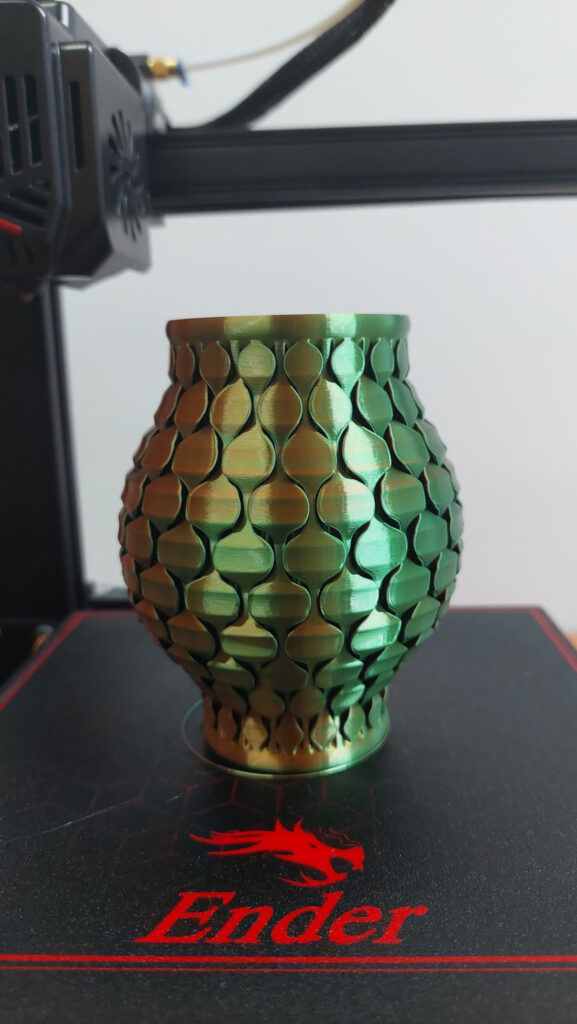
Now set that against the V3 SE. Creality lists it with automatic CR Touch leveling and direct-drive extrusion already built in, and my $100 list didn’t even include a direct-drive conversion. At the V3 SE’s $199, a used Ender 3 Pro plus those upgrades only comes out cheaper if the printer itself costs under about $99, and that’s before filament.
So buy used only if the price clears that bar, or if you enjoy the work for its own sake; the upgrades worth buying breakdown matches each fix to the fault it solves. The community upgrade that helped my Ender 3 Pro most was the hotend airflow upgrade. If you just want to print this weekend, any of the five picks above is the better first printer.
How to Choose Yours in One Minute and Check the Specs Side by Side
Answer one question: what matters most to you? For the most printer per dollar or euro, buy the Centauri 2; for the least setup, the A1; for a big bed at the lowest EU price, the SparkX i7; for the most US filament money, the Ender-3 V3 SE; for a small desk, the A1 mini. If ABS or ASA matters most, save the extra for the Centauri Carbon 2.
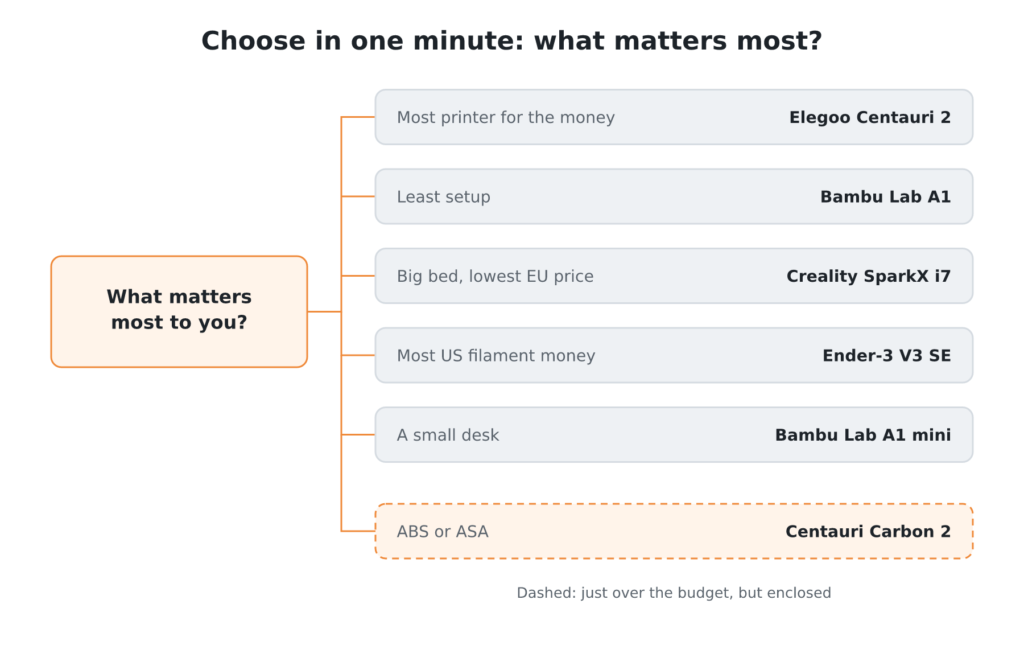
Then check the numbers yourself. The Comparison chart lines up the printers listed on AdditiveRealm, and Compare 3D Printers puts your shortlist side by side. Where a value shows as ‘—’, we don’t have it yet, so confirm it on the maker’s own page before you buy.
Whatever you pick, leave TPU until month two. Creality’s table runs it at just 15 mm/s, which takes a lot of patience in week one. Learn your first layer on PLA, then branch out.
Sources
- Creality: Ender Series Compared: Ender-3 & Ender-5 Series Details
- Elegoo US store: Centauri 2
- Creality UK: How Heat Resistant Is PETG? A Full Guide to PETG Temperature Resistance
- Creality US store: Ender-3 V3 SE 3D Printer
- Creality EU store: Ender-3 V3 SE + 4× Ender PLA (2 Free)
- Bambu Lab EU store: Bambu Lab A1 mini 3D Printer
- Bambu Lab EU store: Bambu Lab A1 3D Printer
- Creality US store: SPARKX i7 3D Printer
- Creality EU store: SPARKX i7 3D Printer
- Elegoo EU store: Centauri 2
- Tom’s Hardware: Creality SPARKX i7 Review: Not just another color bedslinger
- Elegoo US store: Centauri Carbon 2
- Elegoo EU store: Centauri Carbon 2
- Creality US store: Creality K1 3D Printer
- Creality US store: K1C 3D Printer
- Creality US store: Creality K2 SE Combo 3D Printer
- Creality US store: Creality K2 SE 4C
- Creality US store: Ender-3 Pro 3D Printer
- Creality: Creality Filaments’ Parameter Reference Table